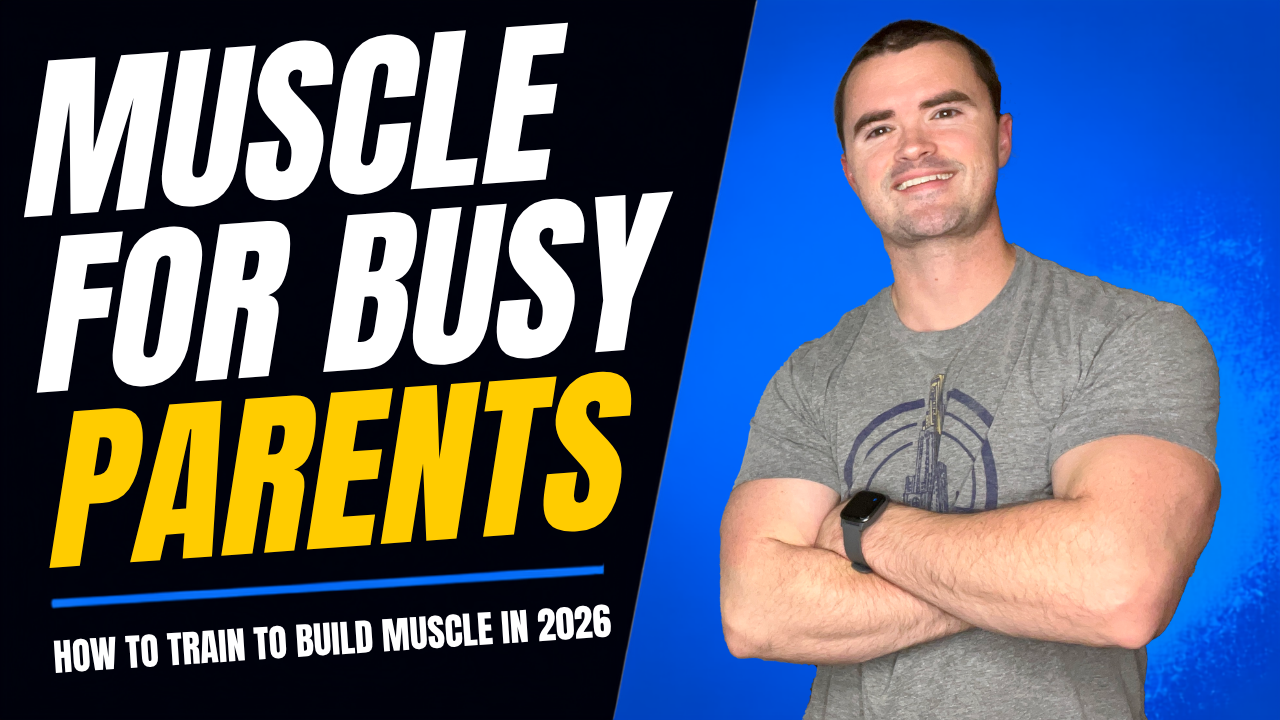
By: Chris Gates
If you’ve spent any amount of time on social media, you’ve probably been left with the impression that building muscle requires living in the gym, following an incredibly complicated workout program, and leaving every workout completely exhausted.
I understand why people think that.
That’s what gets the views.
You see bodybuilders training six days a week, influencers doing endless exercises, and workouts that leave people flat on the floor wondering if they can even make it back to their car.
The problem is that none of those things are required if your goal is simply to build muscle, improve your health, and become stronger.
For busy parents and professionals, muscle building is actually much simpler than the fitness industry makes it seem.
Let’s break down the principles that actually matter.
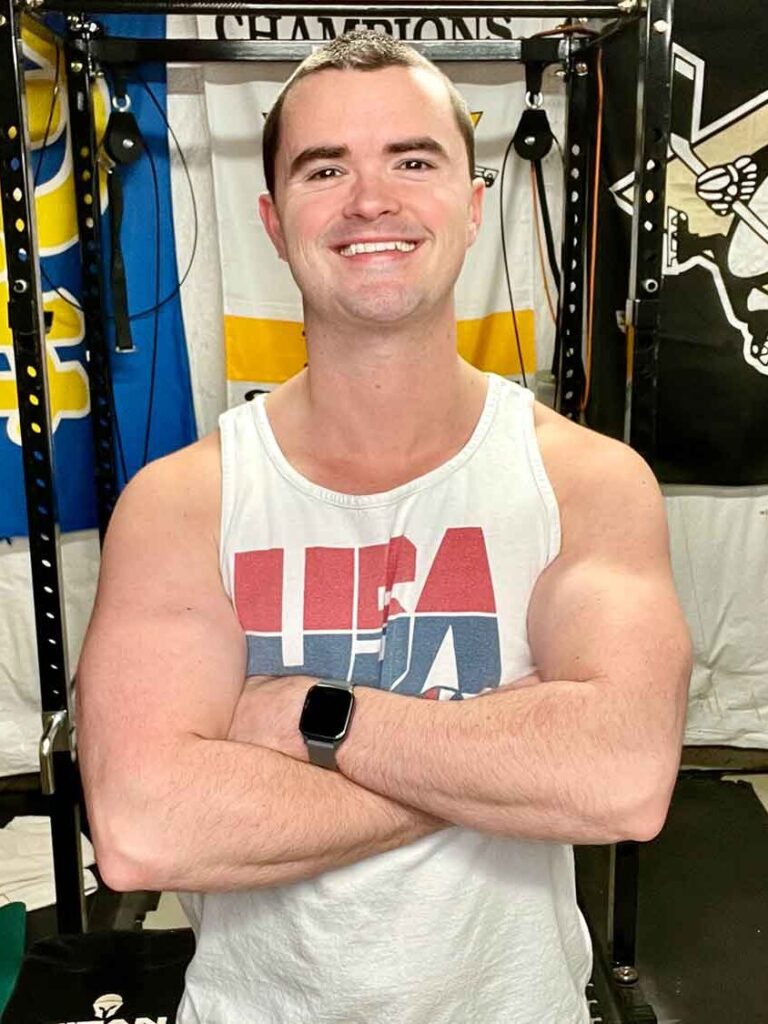
Learn About 1-on-1 Coaching!
I help moms, dads, and busy adults build muscle, burn fat, and make health and fitness progress without giving up everything that you love. If you’ve tried and failed before, and want to finally see results that lasts, learn more about my 1-on-1 coaching program by clicking the link below!
Building Muscle Is Simpler Than You Think
The first thing we need to do is redefine what building muscle actually is.
Building muscle isn’t about punishing your body.
It isn’t about chasing soreness.
It isn’t about sweating as much as possible.
It isn’t about doing more exercises than everyone else.
At its core, building muscle is simply giving your body a reason to adapt.
When you challenge a muscle through strength training, your brain receives the message that what you just did was difficult. Your body wants to become more efficient, so it responds by getting a little stronger and building a little more muscle to make that same challenge easier the next time.
That’s really all we’re trying to accomplish.
Every workout is simply another opportunity to send that signal.
Once you understand that, strength training becomes much less intimidating.
The Four-Part Muscle-Building Formula
Every effective muscle-building program, regardless of how it’s designed, follows the same basic formula.
1. Challenge the Muscle
Your workouts need to provide enough intensity that your muscles are forced to adapt.
If the workout isn’t challenging enough, your body has no reason to change.
2. Do Enough Work
This doesn’t mean doing endless sets or spending hours in the gym.
It simply means doing enough quality work to reinforce that muscle-building signal.
For most busy adults, that’s far less than they think.
3. Recover Properly
Your workouts don’t actually build muscle.
They create the stimulus.
The actual muscle-building happens afterward through proper nutrition, sleep, hydration, stress management, and recovery.
I’ll dive much deeper into that in a future article, but it’s important to remember that recovery is where growth happens.
4. Get Stronger Over Time
This is the piece that ties everything together.
If you’re consistently getting stronger, it’s a very good indication that your body is adapting.
That’s exactly what we’re after.
Get My Free Calorie Calculator!
If you’re looking to build muscle, burn fat, or just generally improve your eating habits, make sure you grab my Calorie Calculator! In less than 60 seconds, it will tell you how many calories, protein, carbs, and fats you should eat to reach your goals.
Intensity Doesn’t Mean Exhaustion
This is probably the biggest misconception I see.
Most people think intensity means:
- Leaving the gym exhausted
- Burning a lot of calories
- Sweating buckets
- Having an elevated heart rate
Those things have very little to do with building muscle.
When we’re talking about intensity, we’re talking about one thing:
How close are you getting to muscular failure?
Failure is simply the point where you physically cannot complete another repetition with good form.
One of the best ways to measure this is by using Reps in Reserve (RIR).
If you finish a set and honestly believe you could have performed:
- 3 more reps = 3 RIR
- 2 more reps = 2 RIR
- 1 more rep = 1 RIR
- No more reps = 0 RIR (failure)
For most people trying to build muscle, I like living somewhere around 1-3 reps in reserve.
That means you’re training hard enough to stimulate growth without creating so much fatigue that recovery becomes difficult.
Remember, the goal isn’t to destroy yourself.
The goal is to challenge the muscle.
Those are two very different things.
You Probably Don’t Need to Train More
One of the most freeing things I can tell busy parents is this:
You do not need to train six days per week to build muscle.
In fact, the majority of my one-on-one coaching clients train just two or three days per week, and many of them make incredible progress.
Here are some of my favorite workout splits.
Two Days Per Week
- Upper Body / Lower Body
- Total Body / Total Body
These are excellent for busy schedules and still provide plenty of opportunity to build muscle.
Three Days Per Week
Three days is probably my favorite balance for most adults.
Options include:
- Three total-body workouts
- Push / Pull / Lower
This provides enough training volume while still allowing for excellent recovery.
Four Days Per Week
For people who enjoy being in the gym a little more often, I typically recommend:
- Upper / Lower / Upper / Lower
or
- Push / Pull / Lower / Total Body
The key is understanding that more workout days usually means shorter workouts, not simply adding more volume.
More isn’t automatically better.
Better is better.
How I Like to Build Workouts
Most of the programs I write follow a similar structure.
We begin with one or two compound exercises before moving into accessory work.
Compound Exercises
These involve multiple muscle groups working together.
Examples include:
- Squats
- Bench Press
- Romanian Deadlifts
- Rows
- Shoulder Press
- Pulldowns
These movements allow you to lift the most weight and provide the biggest return on your time, so I like placing them at the beginning of the workout while you’re fresh.
Accessory Exercises
After that, we move into more isolated work.
Things like:
- Bicep curls
- Triceps pushdowns
- Lateral raises
- Rear delt flyes
- Leg curls
- Calf raises
These allow us to spend more focused time on individual muscles after the heavier work is complete.
There Is No “Best” Exercise
People often ask me:
“What’s the best exercise for building bigger shoulders?”
Or…
“What’s the best chest exercise?”
The honest answer is…
There isn’t one.
Everyone’s body is built a little differently.
Different exercises feel better for different people.
The best exercise is the one that:
- Feels good on your joints
- Fits your available equipment
- Allows you to train hard
- Can be progressed over time
- You’ll actually stick with consistently
Exercise selection becomes more personalized the longer someone trains.
The important thing is choosing movements you can perform well and continue improving over time.
How Heavy Should You Lift?
This question surprises a lot of people because the answer isn’t a specific number.
Your muscles don’t know whether you’re holding a 20-pound dumbbell or a 50-pound dumbbell.
They simply know how much challenge they’re experiencing.
Research has consistently shown that muscle can be built across a very wide range of repetitions—as long as you’re training close enough to failure.
Generally speaking, I like:
- Compound exercises: roughly 5-10 reps
- Isolation exercises: roughly 10-20 reps
Those aren’t hard rules.
They’re practical ranges that allow people to train safely, make consistent progress, and recover well.
Think of the weight as a tool.
Its job is simply to help you reach your target rep range while staying around one to three reps away from failure.
Progressive Overload Is the Real Goal
Every workout becomes a competition with yourself.
Can you improve on what you did last time?
Maybe that means:
- One more repetition.
- Five more pounds.
- Better technique.
- A slower, more controlled tempo.
Those small improvements add up.
If you’re bench pressing 135 pounds today and 155 pounds two months from now, something changed.
Your body adapted.
You got stronger.
You built muscle.
That’s why I encourage my clients to track every workout.
Progressive overload isn’t just a training principle.
It’s your scoreboard.
Don’t Get Distracted by the Wrong Things
The fitness industry loves making people believe they need to constantly chase something new.
The perfect workout split.
The perfect exercise.
The perfect machine.
The perfect amount of soreness.
The reality is that none of those things predict long-term success nearly as well as simply showing up consistently and getting a little stronger over time.
Don’t let the search for “optimal” distract you from what actually works.
Consistency Beats Perfection
Building muscle takes time.
Much more time than losing weight.
You’re literally asking your body to create new tissue.
That isn’t something that happens in a few weeks.
But that’s also what makes it such a valuable investment.
The muscle you build today can benefit you years from now.
It helps you move better, stay stronger, improve your health, and remain capable as you get older.
That’s why I encourage busy adults to stop thinking in terms of six-week transformations and start thinking in terms of years.
The best training program isn’t the one that looks the coolest on Instagram.
It’s the one you’ll still be following a year from now.
If you train with purpose, challenge your muscles consistently, recover well, and keep trying to improve your performance over time, you’ll build muscle.
And perhaps more importantly, you’ll build a healthier body that’s capable of supporting everything else you want to do in life.
That’s a goal worth working toward.