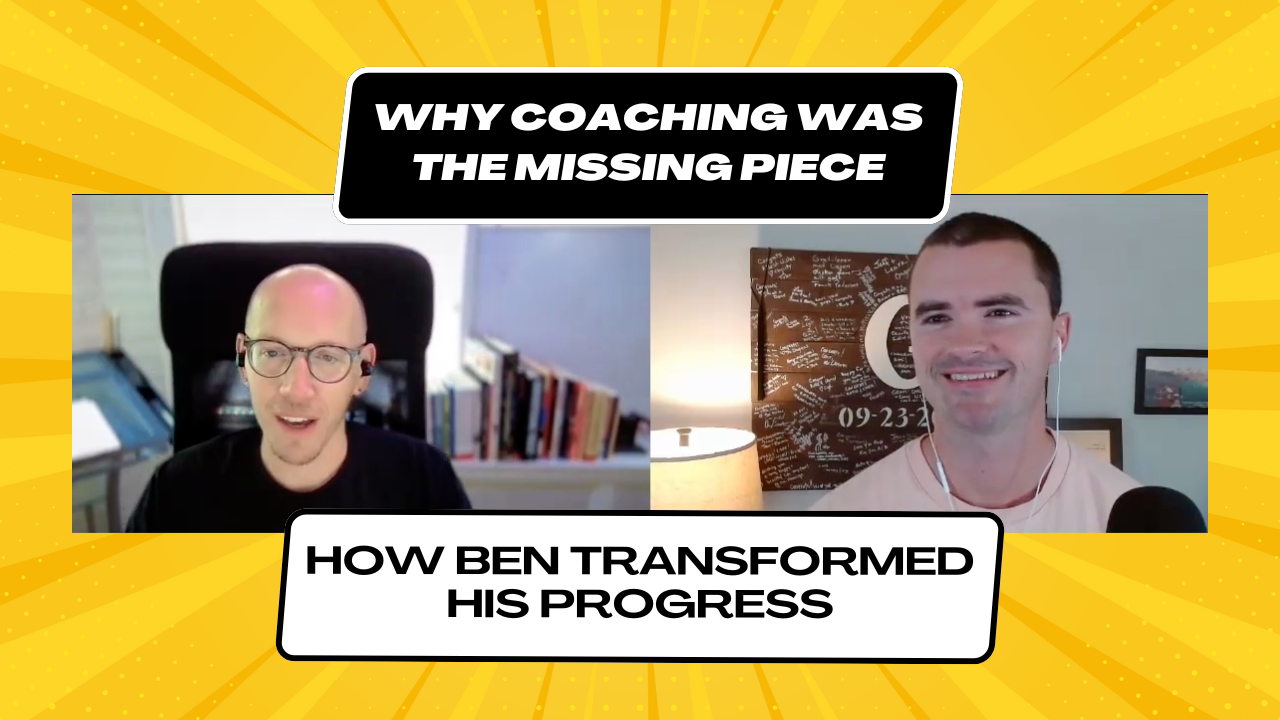
By: Chris Gates
When Ben signed up for 1-on-1 online fitness coaching with me, he wasn’t new to fitness.
Far from it.
He’d been working on his health and fitness since 2016.
- He had lifted weights.
- He had run.
- He had tried boxing.
- And he’d worked his way through a long list of popular workout programs.
The problem wasn’t that Ben wasn’t willing to put in the work.
It was that he kept searching for the next program that would finally help everything click.
“I’ve gone through every influencer you can think of on social media,” Ben explained when we sat down to talk about his experience after four months of coaching.
He had tried programs from BPN, Hard to Kill, Mind Pump Media, Superhero Jacked, SEALFIT and others.
“I like them all and they’re all good,” he said. “It’s just none of them really got me to progressively overload like this one has.”
That realization became an important part of Ben’s transformation.
Because over the next four months, we didn’t constantly search for something new.
- We slowed things down.
- We created structure.
- We tracked his progress.
And we gave the process enough time to actually work.
Learn About 1-on-1 Coaching!
I help moms, dads, and busy adultsbuild muscle, burn fat, and make health and fitness progress without giving up everything that you love. If you’re interested in getting results like Brad, check out my coaching page to learn more!
From Program Hopping to Progressive Overload
Ben is naturally someone who loves variety.
He described himself as having a personality that can become obsessed with something, dive deeply into it, and then quickly find something else that captures his attention.
That can make fitness incredibly engaging.
It can also make consistent progress difficult.
Ben had spent years doing a little bit of everything, but he eventually realized there was a downside.
“You don’t see a result as neatly because you’ve done so many things but shallow,” he said.
So we approached his training differently.
Instead of constantly changing exercises or moving to another program after a few weeks, we used structured eight-week training blocks and focused on getting better at the movements he was already doing.
- More weight.
- More reps.
- Better technique.
- More effort.
Small improvements compounded over time.
Eventually, something that initially felt repetitive became its own form of variety.
“I had to find the diversity in the repetitiveness,” Ben explained.
Instead of needing an entirely new workout, the challenge became trying to beat himself.
- Could he do one more rep?
- Could he use slightly more weight?
- Could he improve upon what he did last week?
Once Ben started seeing that progress, training became a fun competition with the previous version of himself.
Learning How Hard to Train
Another important breakthrough came when Ben learned how to use reps in reserve (RIR).
Previously, if an exercise called for 15 reps, Ben did 15 reps.
It didn’t necessarily matter whether rep 15 was incredibly difficult or whether he could have done five more.
Fifteen was the number, so 15 was where the set ended.
We started shifting his focus away from simply reaching an arbitrary number and toward understanding the intensity of the set.
“I’m feeling all right. Maybe I can probably do three more, so let me just get one or two more in,” Ben recalled.
That seemingly small change helped him better understand what productive strength training actually feels like.
And once we combined that effort with tracking his workouts, Ben could finally see tangible evidence that he was improving.
As he put it: “Two weeks later, I’m actually seeing that.”
That matters.
You can’t consistently compete with your previous performance if you don’t know what your previous performance was.
Apply for Coaching!
If you’re interested in results like Dan’s, submit an application today! After you do, I’ll follow up with you so we can talk more about your goals and what type of program is right for you.
Making Home Workouts Work
Ben also didn’t have the traditional gym setup.
Much of his training happened at home.
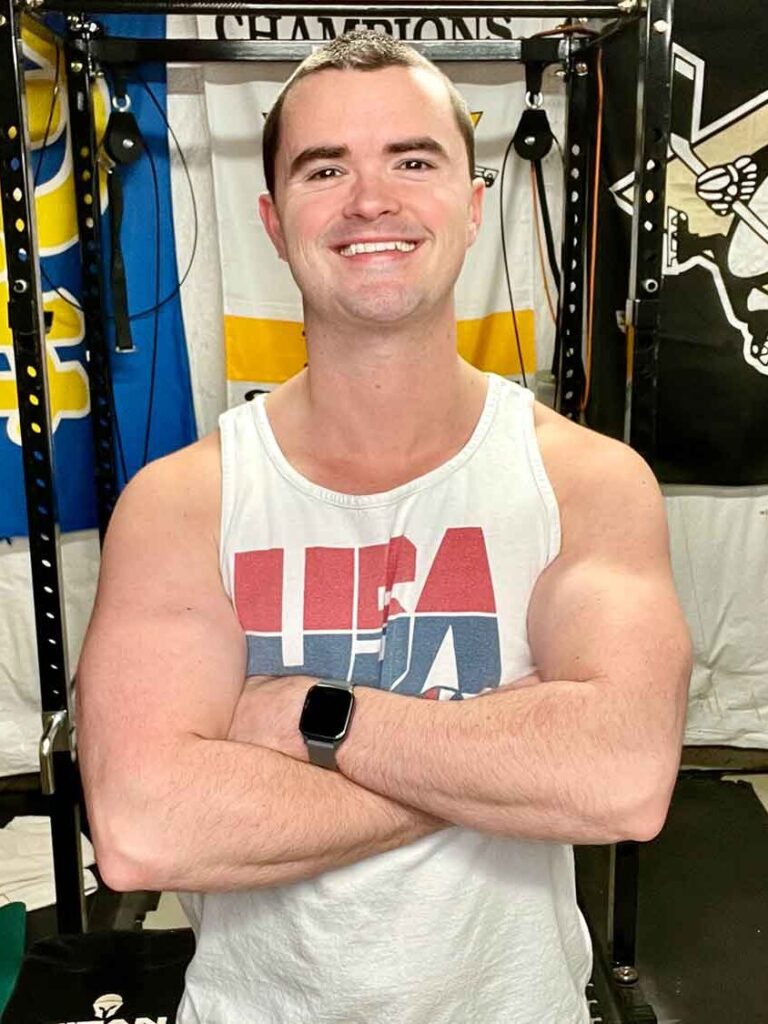
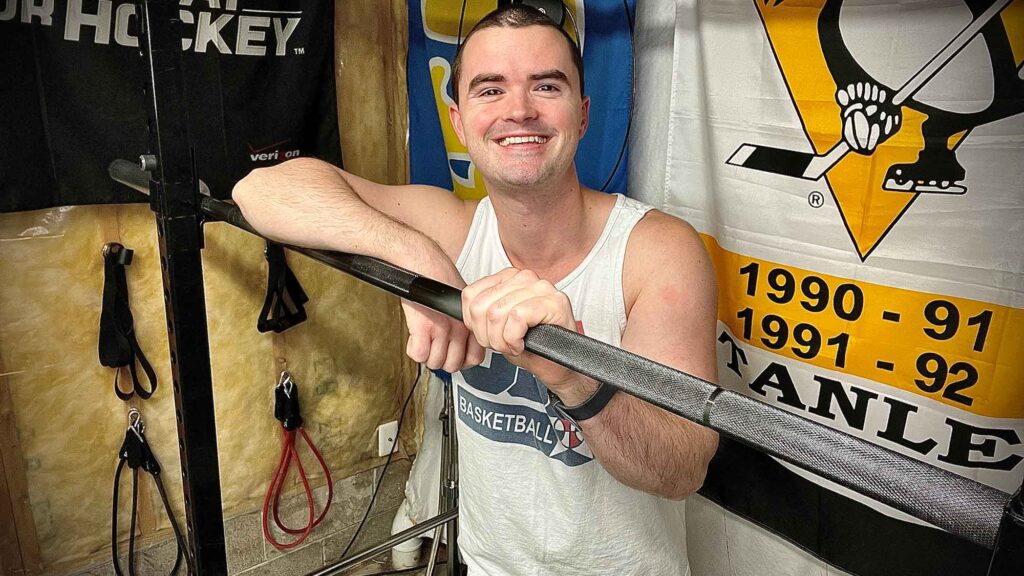
Over the years, he’d gotten incredibly creative with what he had available. He’d used cinder blocks and a broomstick for inverted rows. He’d ruck with weight. He’d even carried an Adirondack chair overhead while doing conditioning on vacation.
During coaching, he eventually added adjustable dumbbells and a bench to his setup, but the lesson remained the same: You don’t need the perfect gym to make progress.
You need a way to challenge your muscles and a plan for progressively doing more.
The equipment helped, but the structure behind what Ben was doing made the bigger difference.
Previously, he might creatively find ways to make a workout challenging — but he wasn’t necessarily documenting it.
Once we started tracking his training, he could see exactly what he’d done and what he needed to beat the next time.
He Didn’t Stop Being a Foodie
Training was only one piece of Ben’s progress.
Nutrition presented another interesting challenge because Ben proudly describes himself as a “foodie.”
And he had no interest in changing that.
Nor did he need to.
“If we’re going to go out to eat and it’s Italian, I’m drinking wine. I’m eating pasta. I’m having bread. I’m eating oil,” he told me. “There might be an amaro after that. There might be gelato after that. That’s the deal.”
I love that.
Because sustainable nutrition shouldn’t require you to eliminate the experiences you genuinely value.
Instead, Ben started creating more structure around the meals that weren’t as important to him.
- Breakfast became fairly standardized.
- Lunch became fairly standardized.
That gave him more flexibility for dinners, weekends, vacations and the experiences where food mattered more.
“I still have those moments where I eat the things that I want,” he explained.
That’s the balance we’re looking for.
The goal isn’t perfection.
It’s creating enough consistency that you can enjoy flexibility without that flexibility completely derailing your progress.
The Scale Didn’t Tell Ben’s Story
Perhaps the most interesting part of Ben’s four months of coaching was what happened with his body weight.
The scale didn’t dramatically change. And that frustrated him.
But when we zoomed out and looked at everything else, a completely different story emerged.
- Ben’s training performance consistently improved.
- His progress photos changed.
- His waistline became noticeably slimmer.
- He added muscle throughout his upper body.
His body composition was changing even though the number staring back at him from the scale wasn’t changing nearly as much as he expected.
And sometimes other people noticed the transformation before Ben did.
That included his daughters.
Ben originally began taking his fitness more seriously in large part because of them. He wanted his two girls to see what it looked like to be strong and live a healthy life.
So comments from them about seeing more muscle in his legs, shoulders and traps carried a lot of weight.
“When other people see it, then it’s, I should step back and see it for myself,” he said.
That’s one of the biggest lessons from Ben’s story.
Your body weight is one data point.
It is not the definition of progress.
If you’re getting stronger, building muscle, losing inches, looking different in progress photos, feeling better and having the people around you notice a difference, something is clearly working.
The scale doesn’t get to overrule all of that evidence.
Sometimes the Answer Isn’t Another Program
At the end of our conversation, I asked Ben what he’d tell someone who is where he used to be — constantly starting and stopping programs and searching for the next answer.
His advice was simple:
“Take a step back and look at what you’ve done, and determine if you’ve actually made progress or not.”
And if you haven’t?
It may be time to stop searching for another quick fix and start looking for something you can actually execute consistently.
Ben put it this way:
“While hopping around and doing that feels like the right thing to do because you’re always looking for the next right answer, it might be a good time to just pause there and see if there’s a more strategic, more sustainable and structured way to do it.”
That’s exactly what we worked to create together.
- Not the perfect workout.
- Not the perfect diet.
- Not a four-month sprint followed by going right back to where he started.
Structure.
Sustainability.
And a process Ben could understand well enough to eventually manage for himself.
That’s progress that goes far beyond a number on the scale.