By: Chris Gates
If you want to lose weight, you need to burn as many calories as possible, right?
Because to lose weight, you need to be in a calorie deficit.
So burn, baby. Burn!
Ehhh… Probably not.
A lot of people focus on tracking the calories they burn each day in order to manage their diet and weight loss goals. And honestly, it’s a strategy I’d urge against you using.
So what’s the best way to track calories burned?
Lucky for you, you’ve come to the right place! In this article, I’m going to outline the best way to track calories burned to reach your fitness goals. And I’ll also explain why most methods of tracking calories burned probably aren’t a great idea.
So let’s break it all down! In this article, you’ll learn about:
- The basics of energy balance, and why calories matter for any fitness goal.
- How accurately you can track calories burned.
- What strategies are best for you to manage your bodyweight.
- Ways that calories burned can be used productively to manage your fitness.
Let’s dive in!
Grab a FREE 21-Day Program!
If you’d like more information on how to lose weight, build muscle, feel healthier, and develop more confidence through fitness, sign up for my mailing list! I send out a new article every week 🙂 You’ll also get my free 21-day program, which will help you start building muscle and burning fat today!
What’s the Best Way To Track Calories Burned? Energy Balance Matters
If you want to change your body composition in some way — whether it be gaining weight, losing weight or maintaining — energy balance is going to determine your level of success.
The term “energy balance” refers to the amount of calories your body burns each day, compared to the amount of calories you consume.
Another way to describe it is calories in vs. calories out.
If you want to lose weight, you need to be eating fewer calories than your body burns. This is called a calorie deficit.
And if you want to gain weight and build muscle, you need to be eating more calories than your body burns. This is called a calorie surplus.
Staying at the same bodyweight would require you to eat at maintenance, which means you’re eating approximately the same amount of calories as your body burns.
Your Fitness Tracker Is Probably Wrong
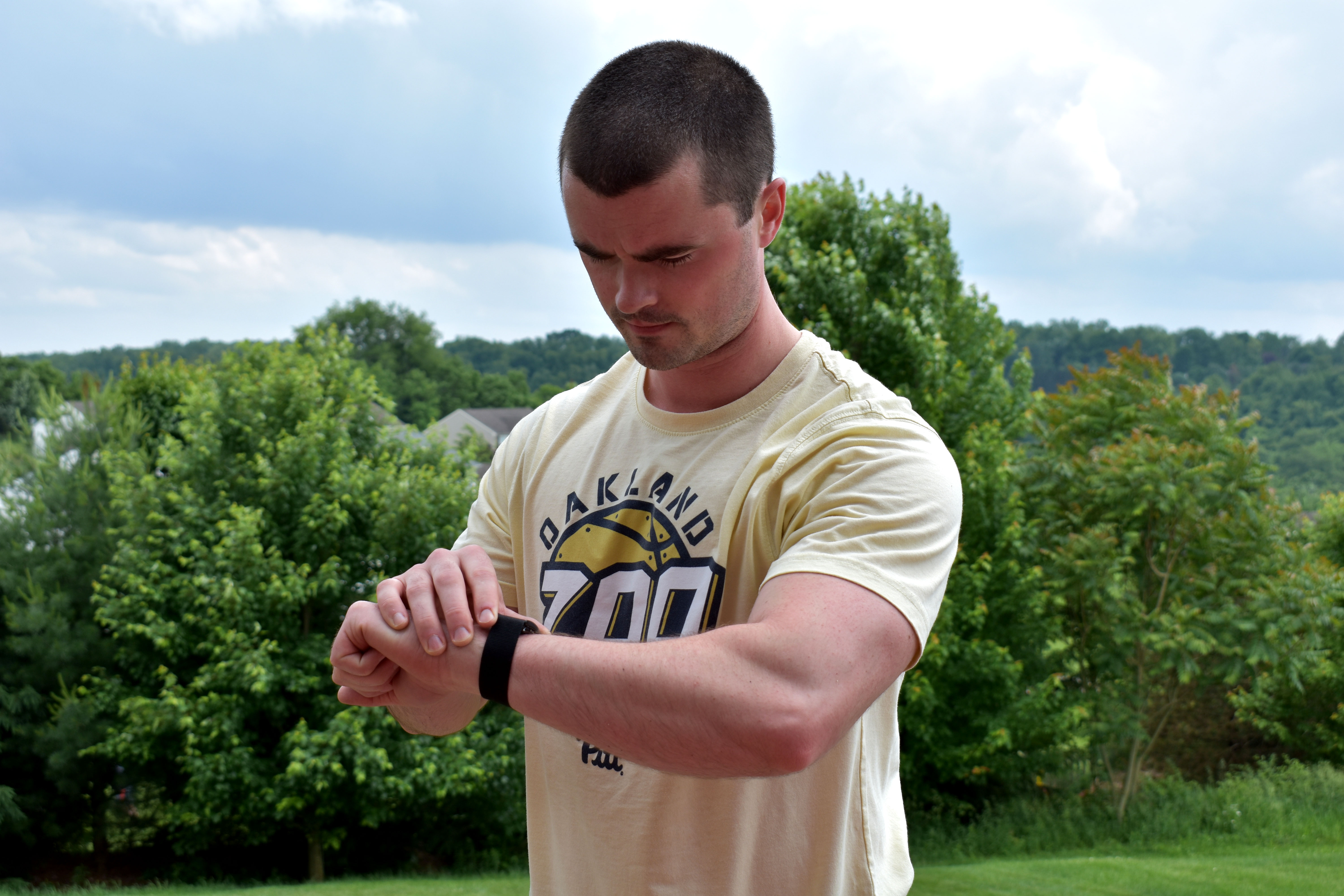
Almost everyone wears a fitness tracker these days.
Whether it be an Apple Watch, Garmin, Fitbit, Whoop Band, or simply your smart phone, there’s something you should know about these trackers.
They are absolutely terrible at tracking calories burned.
The numbers are way off.
A 2017 study out of Stanford examined a bunch of the most popular trackers on the market, and found that the most accurate device was off by around 27 percent.
The least accurate had a 93 percent error rate.
Which, if you’re tallying things up at home… IS A LOT!
The results are even worse when you go by what the cardio machine says. Many treadmills, spin bikes, ellipticals, and other pieces of equipment will give you estimates of calories burned as well.
And they’re not even close.
I’m sharing all of this to explain that tracking calories burned is a foolish, and unproductive habit. There’s no practical way to know how many calories you’re really burning.
So you probably shouldn’t do it.
And it might ruin the pursuit of your goals, or even worse.
What’s the Best Way To Track Calories Burned? The Dangers
First and foremost, by tracking calories burned and relying on that metric to guide your habits with fitness and nutrition, you’re using bad data.
As I explained above, the information isn’t even close to being correct. So let me map out an example of how this can mess with your goals.
Say you want to lose weight. If your watch says you burned 500 calories in your workout, you might think you can eat back those 500 calories, and it won’t affect your weight loss progress.
WRONG.
Knowing how inaccurate fitness trackers are, you probably burned more like 300 calories in that workout. Maybe even less.
And that means you’re actually overeating when you think you’re doing everything right.
That’s a recipe for spinning your wheels and making no progress.
And beyond whether you make progress or not, that’s also a really messed up way to manage your relationship between fitness and food.
You shouldn’t view exercise as an opportunity to “earn” food. But tons of people do it.
And that fitness-food relationship leads many people down the path of developing an eating disorder, which is a damn shame. Because it never had to happen.
So Really… What Is The Best Way To Track Calories Burned?
There is one way you can track calories burned in a productive way, and it’s based around your level of effort.
While the calorie number isn’t going to be accurate, it can sometimes give you a relative idea of the level of effort you put into a given workout. Or even an entire day.
Let me explain…
If you do a cardio workout one day, and your watch says you burned 500 calories. And then you do that same cardio workout a few days later and your watch says you burned 400 calories, it might mean you put a higher level of effort into the first workout.
If you wear your fitness tracker every time you work out, then the numbers it gives you will be relative to you and the work you complete.
- The numbers will not be accurate.
- But they’ll be specific to you.
- So you can use them to gauge your level of effort.
This is a tool used in Crossfit, where the athletes will often be told to do a “row for X amount of calories.” The sport essentially uses calories as a substitute for distance.
They’re not actually concerned with the athletes burning calories. They’re just trying to make sure each athlete has to complete the same amount of work.
You can make a similar comparison with tracking your steps. I think you probably know that your step count is always a little off.
Your watch is going to count little things throughout the day that aren’t actually steps.
- Bouncing
- A bumpy car ride
- Fidgeting around in your seat.
But that’s OK, because at the end of each day you can compare your step count totals to see how active you were. And you can compare each day’s step count to gauge your activity levels across the week.
Tracking calories burned in this way is similar, and it’s a more productive way to use calories burned than using it to clear out space in your calorie deficit.
The Best Way To Manage Your Bodyweight
While you’re tracking your effort in your workouts, plan to track your success with your diet as well.
By that, I mean track your nutrition.
The most effective and most efficient way to manage your diet to lose weight, build muscle, burn fat, or any other bodyweight goal is to track what you’re eating.
If you track your food honestly and weigh things out, or measure your portion sizes, you’ll get a pretty accurate view of how many calories you’re eating each day. You’ll also get to dial in other important elements of your diet, like figuring out how much protein you eat.
- There’s no 27-percent error involved when you do it right.
- You’re not relying on a piece of technology to get it right.
- And that means you can quickly, and relatively easily, figure out how to manipulate your calories to start making progress.
Want to lose body fat? Well, once you get an idea of what your average daily calorie intake is, you can simply reduce those calories to start losing fat.
Want to build muscle? You can add to your calories to make sure you’re in a calorie surplus, as well as make sure you’re eating enough protein.
Tracking what goes in your mouth is exponentially more impactful than tracking calories burned for any bodyweight goal.
What Is The Best Way To Track Calories Burned? In Conclusion
As you hopefully can see, focusing on the amount of calories you burn each day isn’t a great habit to develop.
And that’s simply because of the dangers it presents to both your health and your fitness goals, but also because the data isn’t accurate to begin with.
So instead of trying to burn as many calories as possible, I want to encourage you to direct all of your energy and attention towards tracking your diet. Whatever your goal may be, if you structure your diet in alignment with that goal, you’ll instantly make more progress.
And while you’re at it, make sure your diet is built around whole, nutritious foods.
- Lean meats
- Whole grains
- Fruits
- Vegetables
Those types of foods should make up the majority of your diet — and they’ll provide your body with the nutrition it wants, and needs, to recovery and adapt to your exercise routine.
Trust me.
I’ve worked with clients all over the world, and so many of them have seen their progress skyrocket the minute they focused less on using exercise as a tool for weight management.
Exercise should build you up. Not break you down.
Use your diet to create changes in your body composition.
—
I hope you found this article helpful! If you’re interested in having a coach be there to guide you every step of the way in your fitness journey, well that’s exactly what I do 🙂
Head over to my coaching page to learn about what online coaching is all about. And if you like what you see, fill out an application and let’s talk! I’d love to hear about your goals and chat about what a program might look like for you.
Thanks for reading!
~ Chris