CGF Note: Anthony Daniels has graciously offered to lend his medical expertise to Chris Gates Fitness. Anthony will write articles to help you learn more about your body, how it works, and what we can do to fine-tune our lifestyles in order to be happy, healthy, and strong.
He graduated from Georgia Southern University in Savannah, GA, with a Bachelor’s in Rehabilitation Sciences and a minor in neuroscience before pursuing medical school. He obtained his MD from AUC School of Medicine and currently works on Long Island in an outpatient internal medicine clinic.
By: Anthony Daniels, guest author
I’m pretty positive you know that living an active lifestyle is good for the heart. This has become common knowledge because it is one of those things that we have been reminded of for years.
It’s on the morning news. It’s on cereal boxes. It’s on Subway posters that are marked with graffiti. If I randomly polled people I am positive 99% would say “yes” to the question: “is exercise good for your heart?” What most of that 99% wouldn’t be able to answer though, is why?
That is the dialect that I find is often missing, a bridge between what has become general medical knowledge and an actual understanding by the non-medical community. Unfortunately, this gap in communication continues to widen partially in thanks to medical jargon, rushed office visits, ill-advised Google searches, and often just plain misunderstanding of the patient.
I witnessed it hundreds of times during medical school shadowing when a doctor would tell a patient they need to exercise without explaining why. The patient always nods and agrees (because what else are they going to say) and they leave the room with the same understanding they walked in with.
The outcome is society “knows” exercise is good for the heart but possesses little understanding as to why.
I’ve always been a process-based person and feel that knowing the “whys'” and “how’s” are the best way to understand what you are doing. It is hard for me to get passionate about anything without knowing why it matters. My goal is to combine my medical knowledge along with the passion for physical fitness I share with Chris to help you understand the benefits of maintaining a healthy lifestyle by answering the medical “why’s” and “how’s” that may not be crystal clear.
Since this is my first article for Chris Gates Fitness, I decided we would start with the organ you see the most drug company ads for while trying to watch the evening news: the heart.
After discussing the topic through with Chris, we decided it would be best to break this into a three-part series.
- In this first part I am going to describe the general anatomy and physiology of the heart so that we all start with the same foundation.
- In the next article of this series, I will walk you through how diet and exercise fight high blood pressure.
- And finally, in part three we will discuss how controlling cholesterol through diet and exercise leads to a healthier heart.
Getting to know your heart
The heart, by the basic definition, is a muscle that functions as a pump. It’s truly an incredible organ that we often take for granted. Though it isn’t responsible for love, it is responsible for cycling blood throughout the entire body every minute. There are industries in this world that are spending millions of dollars trying to come up with a pump as efficient, and it is yet to be done. That is why this little thing, which is about the size of your two fists put together, is so important to treat with some TLC.
[accordion]
[toggle title=”The Heart’s Efficiency”] The average amount of blood the healthy heart pumps per beat is about 75 ml. If the average heartrate is 60 beats per minute we can see that every single minute your heart more or less recycles your body’s entire blood supply (60 bpm x 75 ml = 4.5 L, average blood volume ~5 L)! Every minute, of every hour, of every day, of every year.
[/toggle]
[/accordion]
The Circulatory System
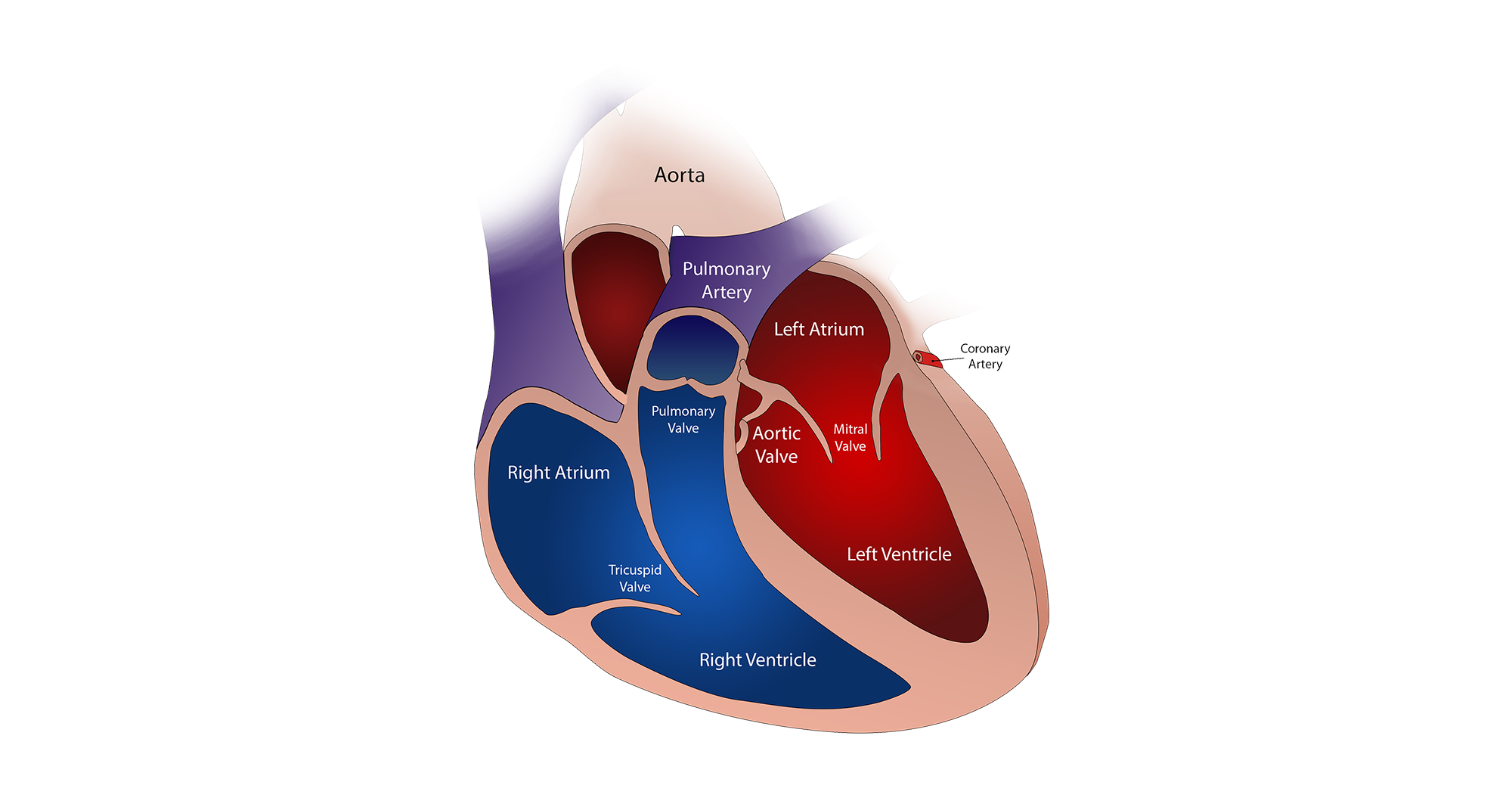
The heart is essentially two pumps that work in tandem with all your blood vessels. The role of blood, specifically red blood cells, is to deliver oxygen and nutrients to every cell in your body. Red blood cells are oxygenated by your lungs when you take a breath, and those red blood cells are carried to the left side of your heart and distributed throughout the body.
[accordion]
[toggle title=”How blood transports oxygen”]
All cells use a substance known as ATP for energy. When red blood cells transport oxygen to muscle cells, the cells are able to continue producing ATP through a reaction known as the citric acid cycle. With oxygen provided, the cell produces 34 units of ATP. The waste products of this reaction are CO2, water, and heat. The red blood cells essentially exchange Oxygen to the muscle cells for CO2. The blood then cycles throughout your systemic system before returning, deoxygenated, to the right side of the heart while carrying the newly acquired CO2. The right side of the heart pumps the blood back to the lungs so we can exhale the CO2 and reload each red blood cell with new oxygen. This delivery and exchange of oxygen to your muscles is essential for proper cell functioning, and that is especially true during exercise.
Alternatively, if your muscles do not receive enough oxygen the cell will produce energy anaerobically (without oxygen). Through this process, the cell can only create 2 units of ATP and the byproduct is lactic acid.
[/toggle]
[/accordion]
The heart is a muscle and, just like your biceps get that sweet pump with a curl session, you can also train your heart to keep up with demands. On the flip side of this, a sedentary lifestyle results in the heart not getting the workout it needs.
Think about how your muscles look less defined when you aren’t adhering to a proper training routine and diet. The heart does a similar thing by adapting to the stresses applied to it. If you train your heart with cardio and exercise, it responds by being better equipped to handle those workouts. For those who do not exercise enough, the heart simply is not strong enough later in life and eventually loses its power to pump blood, resulting in congestive heart failure.
Fortunately taking care of your heart isn’t all that difficult and requires just two steps:
- Eat a healthy diet
- Exercise 150 minutes per week (22 minutes a day).
I want you to think about someone you know who is currently being treated for high blood pressure, also known as hypertension, and now think about those two steps I just mentioned. Chances are the person you’re thinking about is either not eating the healthiest diet or they are not as active as recommended.
The good news is the heart forgives if the person starts to put in the work.
The sad news is most people don’t want to.
The crazy thing to me, is the amount of exercise needed isn’t all that demanding. In fact, the latest American Heart Association guidelines for exercise has been updated to 150 minutes per week of moderate-intensity exercise or 75 minutes per week of vigorous-intensity exercise.
Due to the lack of adherence to these guidelines, hypertension persists at large in our nation, affecting nearly 1 out of every 3 people, and creeping up to nearly 10% of Americans under the age of 39.
In the next article of this series, I will explain how diet and exercise can help prevent high blood pressure. For now, when you are trying to catch your breath after finishing those last reps and you feel your heart pounding, smile knowing that you are likely saving your future self some costly hospital visits.